You’ve seen the portfolios. The prices make sense. You’re seriously considering flying to Colombia to get tattooed. But there’s one question sitting in the back of your mind — and it’s probably the reason you haven’t booked yet:
Is it actually safe?
The short answer: yes, if you choose the right artist and studio. But you deserve more than a short answer. Let’s walk through what professional tattoo studios in Colombia actually look like, what standards you should expect, and how to spot the ones you should avoid.
Colombia’s tattoo industry is more advanced than you think
Most people’s mental image of Colombia is still shaped by outdated stereotypes. The reality in 2026 is very different — especially in the tattoo world.
Colombia has one of the most competitive tattoo scenes in Latin America. Cities like Bogota, Medellin, and Barranquilla are home to artists who regularly compete and win at international conventions. Many have trained or worked in studios across Europe and the US before returning home.
The country hosts major tattoo conventions annually, including Expo Tattoo Colombia, which attracts artists from across the continent. This isn’t an underground scene — it’s a mature, professional industry with high standards.
What a professional studio should look like
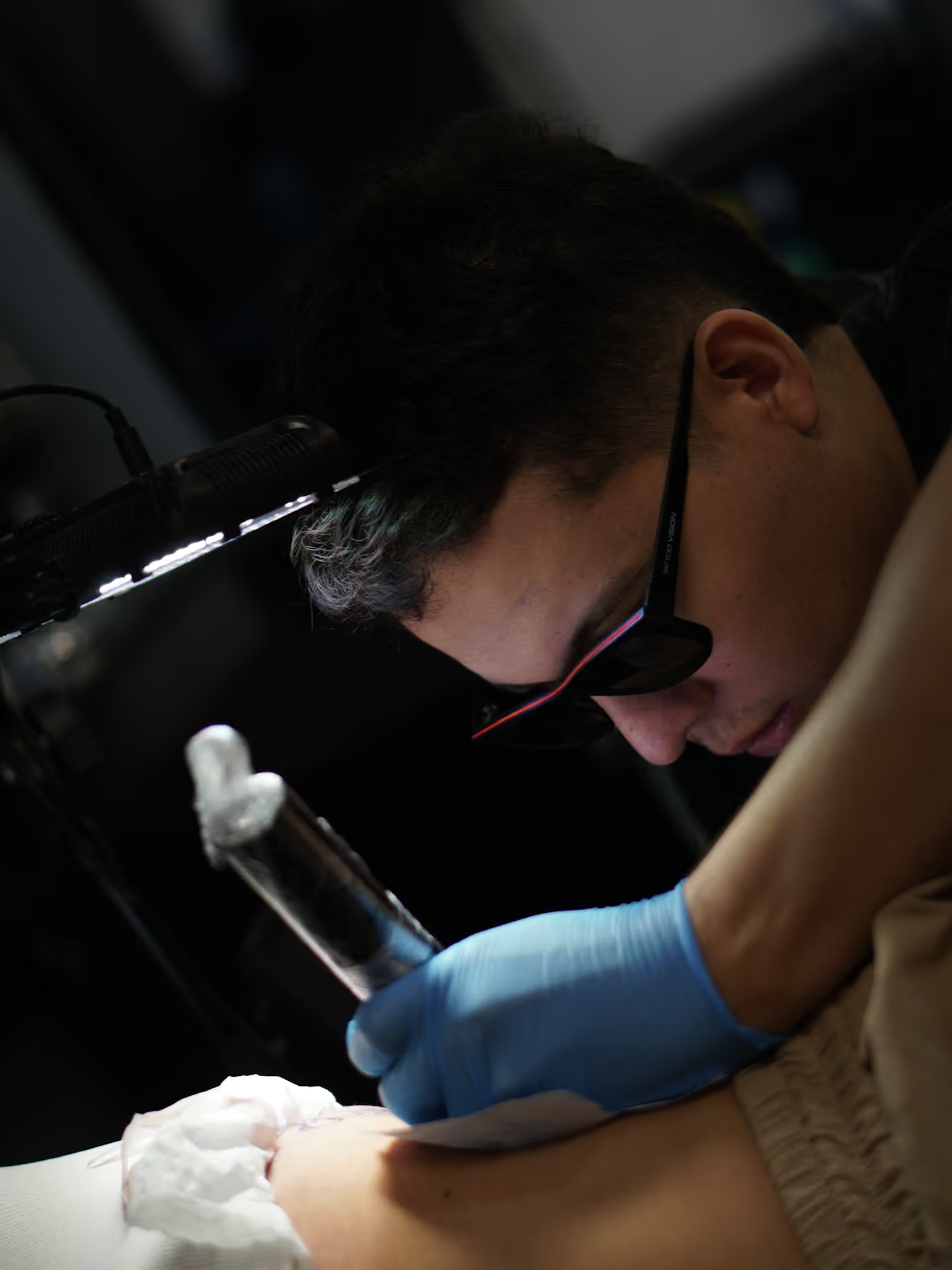
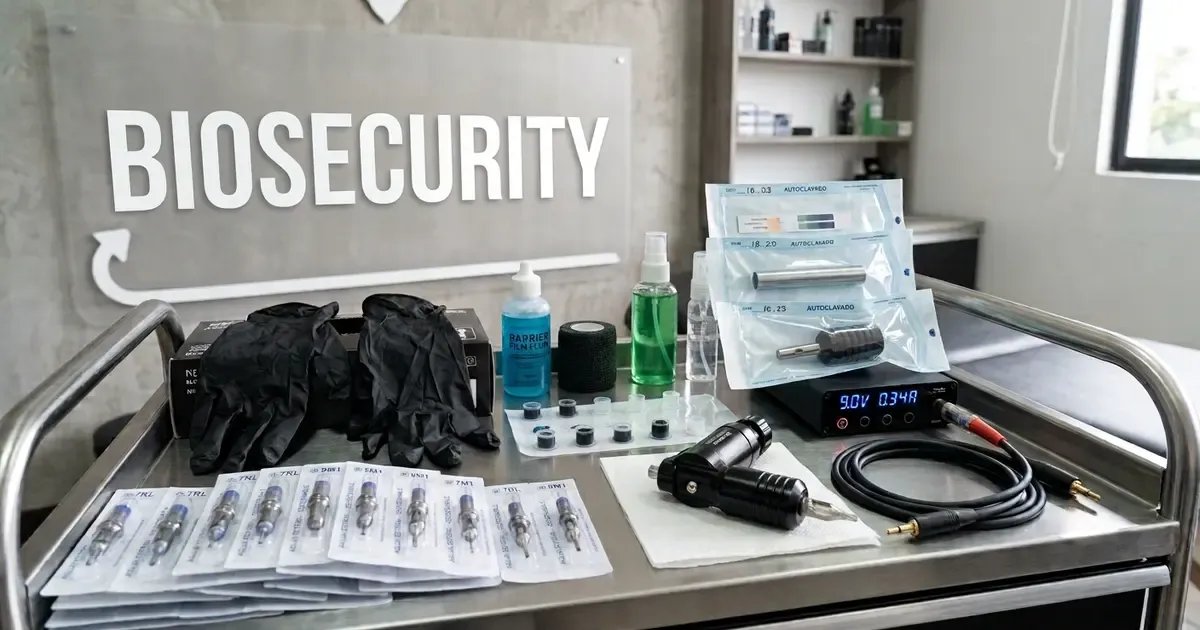
Whether you’re in Brooklyn or Barranquilla, the hygiene standards for a professional tattoo studio are universal. Here’s exactly what to look for:
Single-use needles and cartridges
Every needle and cartridge should be opened from a sealed, sterile package in front of you. No exceptions. If an artist opens equipment before you arrive or uses anything that isn’t visibly sealed, leave.
Autoclave sterilization
Reusable equipment (grips, tubes, certain tools) must be sterilized in an autoclave — a medical-grade machine that uses pressurized steam to kill all bacteria and pathogens. Ask to see it. Any studio worth visiting will be happy to show you.
Medical-grade inks
Professional studios use inks from regulated brands — Eternal Ink, World Famous, Intenze, Dynamic. These are vegan-friendly, heavy-metal-free, and manufactured under pharmaceutical-grade conditions. Cheap, unlabeled ink bottles are a red flag.
Disposable barriers and surface covers
The workstation should be covered with plastic barriers — the machine, clip cord, bottles, and any surface the artist touches during the session. These barriers are replaced between every client.
Gloves — always
The artist should wear medical-grade nitrile gloves throughout the entire session and change them whenever they touch anything outside the sterile field (phone, drawer, light switch).
Clean, organized workspace
This one is obvious but worth stating: the studio should be clean. Not “artistically messy” — actually clean. Floors, surfaces, bathroom. If the general environment looks neglected, the sterile protocols probably are too.
What I do at my workspace
I work out of Inksignia Tattoo Studio in Barranquilla, where I maintain my own workspace with standards that aren’t guidelines — they’re non-negotiable:
- Every needle is single-use, opened in front of you, and disposed of in a sharps container after the session.
- All reusable equipment goes through autoclave sterilization between clients.
- I use exclusively Eternal Ink and World Famous inks — the same brands used in top studios in Los Angeles, London, and Berlin.
- Full disposable barrier coverage on every surface and piece of equipment.
- My workspace is cleaned and disinfected between every appointment.
I trained and worked in Europe, where health regulations for tattoo studios are among the strictest in the world. I brought those same standards back to Colombia — not because Colombian law requires all of them, but because it’s the right way to work. You can see my setup and daily work on Instagram.
Red flags: when to walk away
Not every studio in Colombia (or anywhere) meets these standards. Here’s how to protect yourself:
No portfolio or only digital mockups. If an artist can’t show real photos of healed work on real skin, that’s a problem. Rendered or AI-generated previews are not proof of skill.
Unusually low prices. There’s a difference between “affordable because of economics” and “cheap because corners are cut.” If a full sleeve quote is $150, something is wrong.
Resistance to showing the workspace. A professional artist wants you to see their setup. If someone gets defensive when you ask about sterilization or hesitates to show the autoclave, trust your instinct.
Working from home without proper setup. Some excellent artists work from private studios. But there’s a difference between a dedicated, properly equipped private studio and someone tattooing on a kitchen table. Look for separation between living space and workspace, proper lighting, and all the hygiene protocols mentioned above.
No consent forms or aftercare instructions. Professional studios document the process. You should receive written aftercare instructions and sign a consent form before the session begins.
Common concerns addressed
“What about water quality?”
You won’t be drinking the tap water during your tattoo. Artists use distilled or purified water for any cleaning during the session. The water supply doesn’t affect the tattoo process — what matters is the sterility of the equipment and inks.
“What if something goes wrong and I’m back home?”
Infections from professionally done tattoos are extremely rare. The most common issues — minor irritation, slow healing — can be managed with standard aftercare regardless of where you are. If you follow proper aftercare guidelines, complications are unlikely.
That said, I stay in contact with every client after their session. If you have questions during healing — whether you’re still in Barranquilla or back in the US — you can reach me directly.
“Do I need any vaccines or health precautions?”
No special vaccines are needed for getting tattooed in Colombia. Standard travel recommendations apply (check CDC guidelines for Colombia), but the tattoo itself doesn’t introduce any additional health requirements beyond what you’d need for any tattoo anywhere.
“Is Barranquilla safe for tourists?”
Barranquilla is one of Colombia’s major cities and a significant business hub. The areas where professional studios operate — Norte Centro Historico, the northern neighborhoods — are modern, well-connected, and safe for visitors. Uber and DiDi work throughout the city, and the airport has direct flights from Miami and Fort Lauderdale.
How to verify an artist before you fly
Before booking a session with any artist in Colombia, do this:
- Review their Instagram and portfolio. Look for consistency across dozens of pieces, not just 5 hero shots. Pay attention to healed work.
- Ask for healed photos. Any confident artist will have these readily available.
- Request a video call. A quick call lets you see the studio, meet the artist, and ask questions. If they refuse, move on.
- Check Google reviews. Real client experiences — especially from other international visitors — are valuable signals.
- Ask about their process. How do they handle design? How many sessions? What’s the aftercare protocol? Professional artists have clear, detailed answers.
The bottom line
Getting a tattoo in Colombia is as safe as getting one in any major US city — provided you do the same due diligence you’d do anywhere. The equipment is the same. The inks are the same. The techniques are the same. The only difference is the price.
The artists who compete internationally, train abroad, and maintain strict hygiene protocols are the ones you want to book with. And Colombia has plenty of them.
Ready to see the work for yourself? Check the portfolio or get a free quote to start planning your piece.